The most common question we are asked, and the hardest one to answer honestly in a single number, is what a kitchen costs. Any studio that gives you a figure before seeing the room is guessing, and the guess will be low — because a low guess wins the meeting and the difference gets recovered later in variations.
What is genuinely useful is understanding where the money in a kitchen goes. Once you know that, you can read any two quotes side by side and see exactly why one is half the other, which is a more valuable skill than knowing our price.
How kitchens are quoted in Pakistan
The convention here is a rate per running foot, quoted separately for base units and wall units. It is a reasonable way to price a straight run of boxes and a poor way to price a kitchen, because the boxes are the cheapest part of what you are buying.
Sitting outside that per-foot rate, in almost every quote you will receive, are the worktop, the tall and pantry units, the hardware, the lighting, the extraction, and the sink and tap. Two studios can quote an identical rate per foot and land thousands of rupees apart once those are added. When you are comparing, compare the total for the whole room — never the rate.
The carcass: the part you never see and always pay for
The carcass is the box behind the door. It is invisible once the kitchen is installed, which is exactly why it is the first place a price gets cut.
In Pakistan the realistic choices are commercial board (widely sold here as lasani), moisture-resistant MDF, plywood, and marine or BWP-grade plywood. The spread in cost between the cheapest and the most appropriate is significant, and the spread in how they behave in a Karachi or coastal Lahore summer is larger still. We have written about that choice in detail in our guide to kitchen cabinet materials in Pakistan.
The short version: a kitchen carcass in this climate has water underneath it and steam above it for its whole life. Ordinary board is fine in a wardrobe and a false economy under a sink.
The fronts: where the look lives
Doors and drawer fronts are the largest visible surface in the room and the widest price band in the quote. High-gloss acrylic, super-matte anti-fingerprint laminate, tactile wood-effect boards, lacquered glass and solid timber all sit at different points, and the differences between them are as much about maintenance as money.
- High gloss is the most reflective and the least forgiving — it shows every fingerprint and every wave in a poorly pressed panel.
- Super-matte with an anti-fingerprint coating has become the default in this market for good reason: it photographs well, it is calm to live with, and it does not need wiping twice a day.
- Wood-effect and real timber cost more and age better. A timber front that has taken ten years of use looks like ten years of use, which is not the same thing as looking worn out.
- Lacquered glass is durable and easy to clean, but it needs to be manufactured accurately, because glass shows a bad shadow gap more cruelly than any other material.
You can see seven of these finishes on the same island, side by side, in our material visualiser — which is a faster way to narrow the choice than any description.
The hardware: the small number that decides the feel
Hinges and runners are the only parts of a kitchen you physically touch, several thousand times a year. They are a modest share of the total and close to all of the daily experience, and they are the single easiest place for a quote to be quietly reduced.
Named hardware from Blum or Hettich is rated for a weight and a cycle count. Unbranded gear is not rated for anything. Both feel identical on the day of handover; eighteen months later one of them has a drawer that has dropped at the front and no longer closes flush. There is more on this in our cabinet hardware guide.
“If a quote will not name the hardware brand and series in writing, that is where the saving is being made.”
The worktop
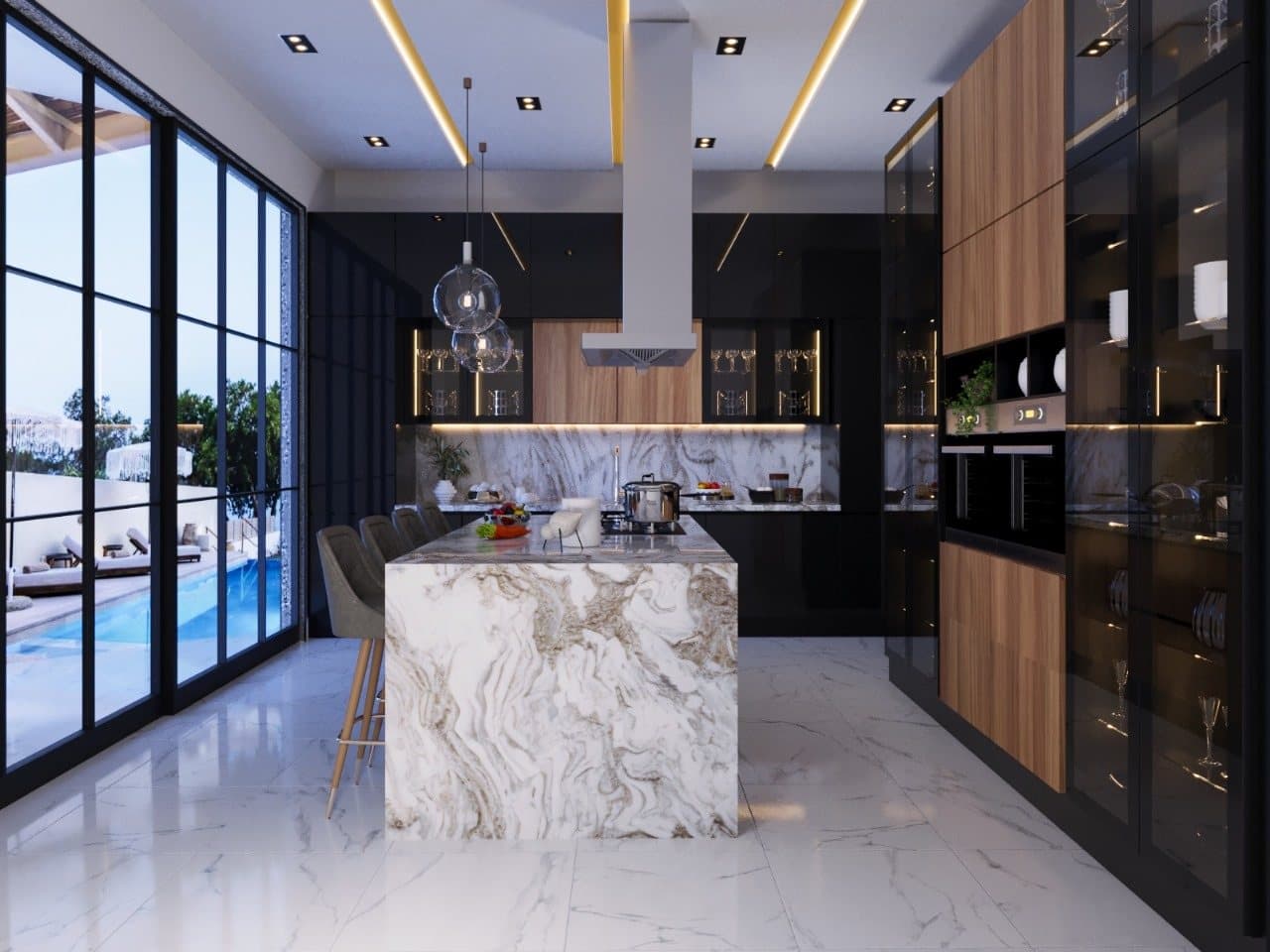
Worktops in Pakistan run from local granite through engineered quartz to imported porcelain and marble, and they are priced by area, so a large island moves this line fast. Marble is the most beautiful and the most demanding — it stains, and in a kitchen where turmeric and oil are in daily use, that matters more here than in the European magazines the look comes from.
Quartz is the pragmatic answer for most families. Where a client wants marble, we would rather put it on an island that is admired than on a run beside the hob that is worked on.
Extraction, lighting and the things people forget
A kitchen cooking Pakistani food produces more airborne oil than the same kitchen in Europe, and undersized extraction is the most common regret we hear about a year in. It belongs in the budget from the beginning, not as an afterthought once the cabinetry has eaten the money.
The same is true of lighting. Under-cabinet task lighting on the working run and a sensor light inside the tall units cost little and change the room at night more than any finish does.
The five lines every quote should be split into
Before comparing anything, ask every studio to break the total into the same five lines. If one will not, you have learned something useful about them:
- Carcass — the board, its grade, and whether it is moisture-resistant.
- Fronts — the material, the finish, and the edge banding used.
- Worktop — the material, the thickness, and who templates it.
- Hardware — brand and series, in writing, for hinges, runners and lift systems.
- Lighting, extraction and installation — including site adjustment after delivery.
Do that and the quotes stop being incomparable. This is how we price every project, and it is the reason our figure is sometimes higher than the one next to it and always explicable. Our process page sets out the whole sequence from survey to handover.
So what will yours cost?
Honestly: it depends on the run length, the finish and the hardware, and anyone who tells you otherwise before measuring is selling you the meeting rather than the kitchen. What we can do is survey your space, draw it in 3D so you can walk through it, and give you an itemised figure you can hold us to.
If you are at the stage of gathering numbers, send us the plans or the address and we will tell you what we would do with the space, including where we would spend less. You can also look at finished kitchens across DHA, Clifton and PECHS to calibrate what a given budget actually buys.
Common questions
- How is a modular kitchen priced in Pakistan?
- Almost always by running foot, quoted separately for base units and wall units, with the worktop, tall units, hardware and lighting added on top. That is why two quotes with the same per-foot rate can still land far apart — the rate only describes the boxes.
- Why do two kitchen quotes differ so much?
- Four things account for most of it: the carcass board, the front material and finish, the hardware brand, and whether installation, edge banding and site adjustment are inside the price or added later. Ask for all four in writing and the gap usually explains itself.
- What percentage of a kitchen budget is hardware?
- Enough to matter. Hinges, runners and lift systems are a meaningful share of a well-built kitchen and close to nothing in a cheap one — which is precisely why a quote that will not name the hardware brand should be read carefully.
- Is a bespoke kitchen more expensive than a ready-made one?
- Per foot, usually yes. Per usable metre of storage, often not — a made-to-measure run has no filler panels and no dead corners, so you buy less kitchen to get more of it.